Tuesday, 21 May 2013

Practice paper 2


Here's what I'm listening to...

Queens of the Stone Age - A song for the dead

Blogging for about one and a half hours now

Hi everyone,

Sorry it took me a little while longer than I expected to get on here. I'm going to be blogging until about 9pm and will try and get everything online that you asked for.

If anyone wants to complete any practice questions, please do and I will mark them for you during the lesson tomorrow!

Any other questions, just ask.

NW

Practice Paper 1 - This is what the questions look like!


English Literature
Unit 2: Understanding Poetry
Higher Tier

Tuesday 17 January 2012 – Morning
Time: 1 hour 45 minutes
5ET2H/01
Questions and Extracts Booklet
Do not return this booklet with your Answer Booklet
You may use a clean copy of the Edexcel Anthology


P40020A
©2012 Pearson Education Ltd.

Edexcel GCSE

P40020A

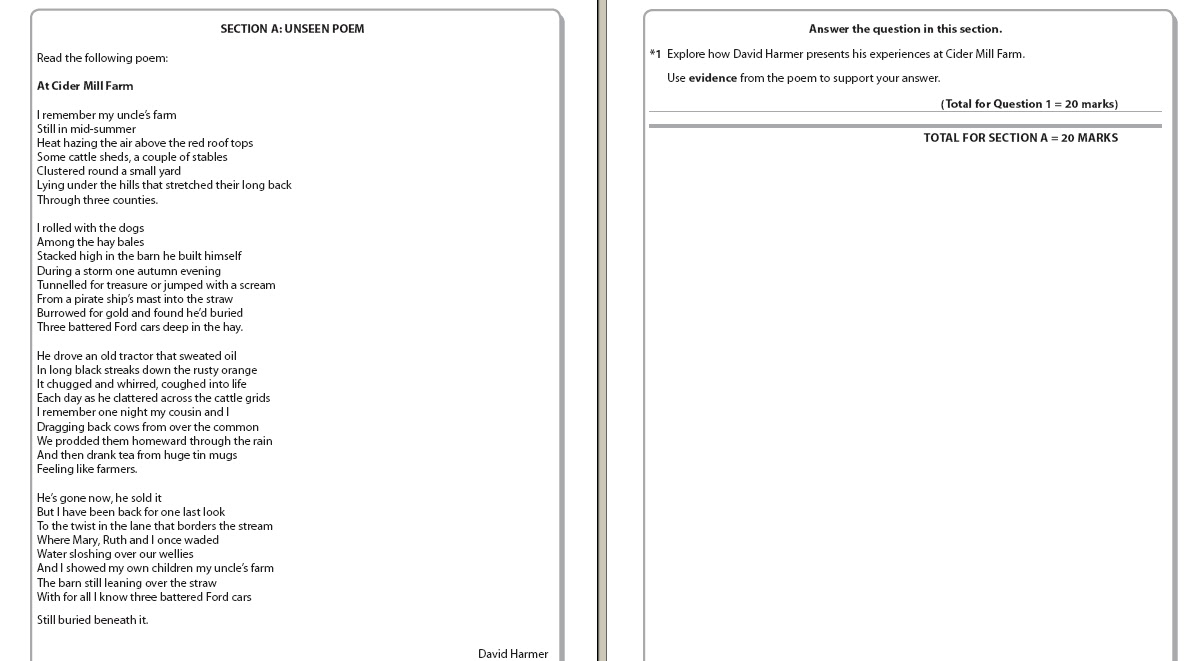
SECTION A: UNSEEN POEM

Read the following poem and answer Question 1:

What has happened to Lulu?
What has happened to Lulu, mother?
What has happened to Lu?
There’s nothing in her bed but an old rag-doll
And by its side a shoe.
Why is her window wide, mother,
The curtain flapping free,
And only a circle on the dusty shelf
Where her money-box used to be?
Why do you turn your head, mother,
And why do tear drops fall?
And why do you crumple that note on the fire
And say it is nothing at all?
I woke to voices late last night,
I heard an engine roar.
Why do you tell me the things I heard
Were a dream and nothing more?
I heard somebody cry, mother,
In anger or in pain,
But now I ask you why, mother,
You say it was a gust of rain.
Why do you wander about as though
You don’t know what to do?
What has happened to Lulu, mother?
What has happened to Lu?
Charles Causley

*1 Explore how Charles Causley presents the thoughts and feelings of the speaker in the
poem ‘What has happened to Lulu?’.

Use
evidence from the poem to support your answer.


(Total for Question 1 = 20 marks)

TOTAL FOR SECTION A = 20 MARKS
 

SECTION B: ANTHOLOGY POEMS


Collection B: Clashes and Collisions
Answer Question 3, parts (a) and (b). There is a choice of questions in part (b).

(a) Explore how the writer conveys her thoughts and feelings about the coming of
war in ‘Invasion’.

Use evidence from the poem to support your answer.


(15)

EITHER

(b) (i) Compare how the writers explore different thoughts and feelings about the
coming of war in ‘O What is that Sound’ and ‘Invasion’.

Use evidence from the poems to support your answer.

You may include material you used to answer 3(a).


(15)

OR

(ii) Compare how the writer of one poem of your choice from the ‘Clashes

and Collisions’ collection explores different ideas about war from those in
‘Invasion’.

Use evidence from the poems to support your answer.
You may include material you used to answer 3(a).

(15)
(Total for Question 3 = 30 marks)
OVERLAPPERS

Use this acronym to analyse ANY poem that is put in front of you.

ie, see if any of this stuff is in the poem and use it as your basis to write your paragraphs:

Onomatopoeia
Vocabulary choices and groups
Enjambment
Rhetorical Questions
Lexical Field
Alliteration and Assonance
Personifications/Dehumanisations
Poet/Background
Emotive Language
Rhythm and Rhyme
Stanza Length
Similes and Metaphors
Juxtapoistions

If you find any of these things, you can then turn it into a PEE paragraph in the usual way by making your POINT (what has been done) providing EVIDENCE (where do you see it) and then EXPLAINING yourself (how does this help to answer your question).

Wall of Shame

Thanks to the following people for showing such awesome commitment, and turning up to the after-school session ("SARCASM ALERT!!!")

Lois
Dan 'al
Helen
Shaun
Alex Wigwam
Al Fraze
Sam Shaw


Annotating the unseen poem - and example answer

These are the words and phrases I highlighted when I first read the poem:

Stealing

The most unusual thing I ever stole? A snowman.              Use of rhetorical question to involve reader
Midnight. He looked magnificent; a tall, white mute          Use of 'Midnight' sets time and makes the action seem mysterious
beneath the winter moon. I wanted him, a mate            Almost personifies the moon, like it is looking down on him
with a mind as cold as the slice of ice                     Makes the poet sound unfeeling and a bi psychopathic
within my own brain. I started with the head.          Makes him sound like he has split personality/ brutal

Better off dead than giving in, not taking           Makes him sound criminally insane, stubborn
what you want. He weighed a ton; his torso,     Snowman is personaified to make it sound more real and brutal
frozen stiff, hugged to my chest, a fierce chill       Emotive language 'hugged' makes us wonder if he has been neglected
piercing my gut. Part of the thrill was knowing
that children would cry in the morning. Life's tough.   Image makes us dislike him - use of cliche shows him to be uncaring

Sometimes I steal things I don't need. I joy-ride cars    Enjambment makes the line flow like he can't stop confessing
to nowhere, break into houses just to have a look.
I'm a mucky ghost, leave a mess, maybe pinch a camera.     Metaphor makes him seem invisible - frightening but makes us pity him

I watch my gloved hand twisting the doorknob.    strange use of tense/person makes him sound like he can't control his actions

A stranger's bedroom. Mirrors. I sigh like this - Aah.  Structure of sentences makes him seem panicked.
Use of audial imagery/onomatopoeia helps us imagine his reaction but makes him seem sarcastic.

It took some time. Reassembled in the yard,
he didn't look the same. I took a run
and booted him. Again. Again. My breath ripped out     Violent lexical field to add tension
in rags. It seems daft now. Then I was standing       Insignificant word 'daft casuses juxtaposition with violent imagery
alone among lumps of snow, sick of the world.    Use of juxtasposition allows 'alone' to appear in a more important place.

Boredom. Mostly I'm so bored I could eat myself.          Isolated word seems to sum up the point of the poem.
One time, I stole a guitar and thought I might
learn to play. I nicked a bust of Shakespeare once,      Juxtaposition of class/ crime causes effect.
flogged it, but the snowman was the strangest.              'nicked'/'flogged' sound working class.
You don't understand a word I'm saying, do you?           Another rhetorical question to finish


Language/Imagery:

Rhetorical questions
Metaphors
Unusual Lexical Field
Imagery
Onomatopoeia
Emotive Langauge
Working class vocab
Cliche

Structure:

Enjambment
Isolation of important words
Shortened sentences to add emphasis to certain themes
No rhyme
Equal length stanzas


Done - in 5 minutes!